Holly - Finally a Way to Learn German with an Easy Way
Every German noun has a gender — and no single rule predicts it. Here's why that trips learners up, and the color-based shortcut that actually makes it stick.
See Holly Deutsch - German Tutor in action
Why "just memorize it" doesn't work
German nouns are masculine (der), feminine (die), or neuter (das) — and the gender usually has nothing to do with logic. "Das Mädchen" (the girl) is neuter. "Die Person" is always feminine, even for a man. There are a few ending-based patterns, but they cover a fraction of real vocabulary, and exceptions pile up fast.
That's why most learners default to rote memorization — and why most of them forget the article within days, even after getting the word itself right.
A few examples of the problem
Nothing about these words hints at their gender — you just have to know it:
The shortcut: let color carry the gender
Instead of pairing each noun with a grammar label, pair it with a color: blue for der, pink for die, green for das. Color is one of the easiest things for the brain to recall — far easier than an abstract category like "masculine."
This is the whole idea behind Holly Deutsch - German Tutor. Your coach Holly texts you a word as a colored picture, and after a few new words, quizzes you on an earlier one — so the color, and the article, actually stay with you.
- Every word is shown in the color of its article — no labels to remember.
- Spaced quizzes bring back earlier words instead of only testing what's fresh.
- It runs as a chat, so a few minutes at a time is enough.
How the color method plays out
See It
A new word arrives as a picture, colored by its article.
Recall It
A few messages later, that same word comes back as a quiz question.
Check It
Type der, die, or das — get it wrong, and you see the color again, not just the correction.
Keep It
Repeat exposure across real conversations is what makes the article automatic.
Frequently asked questions
Why does German have three articles instead of one?
German nouns are grammatically masculine, feminine, or neuter, and each gender takes its own article — der, die, or das. English lost this system centuries ago, which is why it feels unfamiliar to English speakers.
Is there a rule for der, die, das?
There are some patterns — for example, many words ending in "-e" are feminine, and most ending in "-chen" are neuter — but they only cover a portion of vocabulary. Most nouns still have to be learned individually.
Do plural German nouns have their own article?
Yes — all plural nouns use "die," regardless of their singular gender. Holly Deutsch - German Tutor focuses on singular-noun articles first, since that's where most learners get stuck.
What's the fastest way to memorize German gender?
Pairing each word with a strong, consistent cue — like a color — tends to work faster than memorizing lists, because it gives your brain something concrete to attach to an abstract category.
Does an app really help with this?
A well-designed one can, especially if it brings words back for review instead of only introducing new ones. Holly Deutsch - German Tutor is built around exactly that cycle of color exposure and spaced recall.
Is Holly Deutsch - German Tutor free?
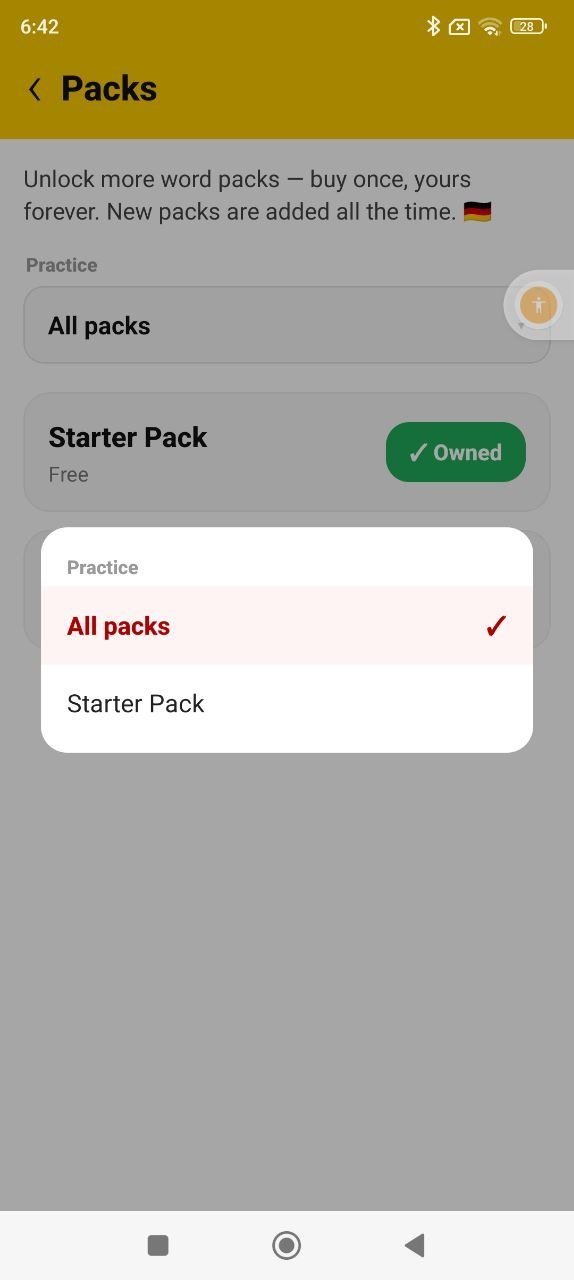
Yes. It starts with a free pack of everyday German words, with more word packs available as a one-time purchase, yours forever.
Stop guessing. Start seeing color.
Chat with Holly and let color do the work that grammar rules can't.
Get Holly Deutsch - German Tutor